

neogene
23 ma → 2.58 ma
a world increasingly recognizable
section titled “a world increasingly recognizable”the neogene was the second great stage of the cenozoic.
it began approximately 23 million years ago and ended 2.58 million years ago.
if the paleogene had been a reconstruction phase after the great extinction, the neogene was a consolidation stage.
many ecosystems continued to change. many lineages continued to expand. the planet began to show increasingly familiar traits.
the earth continued to transform, but it was already advancing towards a world much more similar to the current one.
slow changes, enormous consequences
section titled “slow changes, enormous consequences”during the neogene, changes were not sudden like in a great extinction.
they were long, cumulative and deep processes.
the climate continued to cool. many regions became drier. continents continued to move. ocean currents changed.
all that altered ecosystems on a global scale.
in this new context:
- more open environments expanded
- jungles retreated in some regions
- large extensions of grasslands appeared
- animals had to adapt to more variable conditions
the neogene was a stage of deep transformation, although silent.
the expansion of grasslands
section titled “the expansion of grasslands”one of the most important features of the neogene was the expansion of prairies and savannas.
in many parts of the world, forested landscapes gave way to more open environments.
this completely changed terrestrial life.
animals that lived in these spaces needed new adaptations:
- move quickly
- travel long distances
- detect predators in open terrain
- feed on harder and more abrasive vegetation
grasslands were not just a new landscape.
they were a new way of organizing life on dry land.
mammals in expansion
section titled “mammals in expansion”if in the paleogene mammals had begun to diversify, in the neogene that expansion continued strongly.
many groups became more abundant and varied.
forms increasingly close to modern lineages appeared.
among them stood out:
- primitive horses increasingly better adapted to running
- ancient elephants and other large herbivores
- deer, bovids and other grassland mammals
- increasingly specialized predators
terrestrial life became more dynamic.
in many places, ecosystems began to resemble more the savannas, plains and open spaces that we associate with recent times.
birds, seas and new balances
section titled “birds, seas and new balances”birds continued to occupy many niches and diversify in different environments.
at the same time, the neogene oceans also housed a rich and changing fauna.
marine mammals continued to evolve. fish and invertebrates continued to form complex ecological networks. large marine predators dominated certain ecosystems.
the neogene was not just a terrestrial history.
it was also an important stage for the evolution of life in the seas.
ecosystems in motion
section titled “ecosystems in motion”the neogene ecosystems were not yet identical to the current ones, but they were already much more familiar.
many open landscapes became common. many animal groups acquired more modern forms. many ecological interactions began to resemble those we know today.
even so, it was still a different world.
there were extinct species. there were combinations of fauna that no longer exist. there were ecological balances proper to their time.
the neogene was not yet the present, but it already left it to be seen in the distance
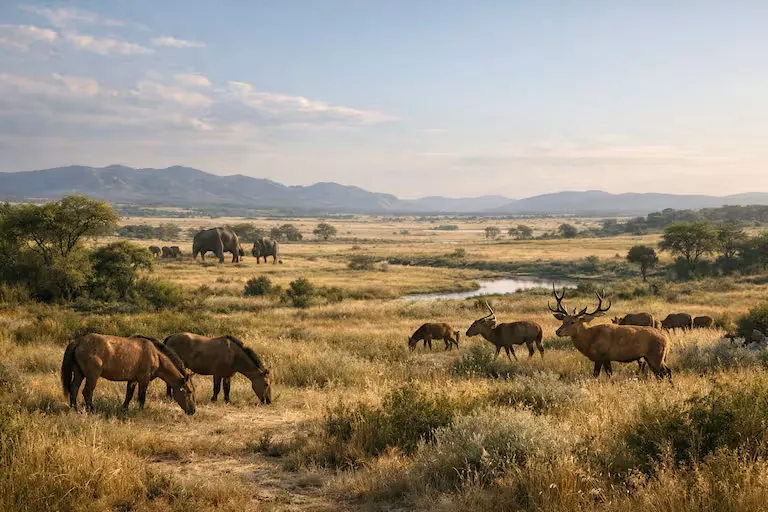
> neogene landscape, with more open ecosystems and a fauna increasingly closer to the modern one
changes in climate and the planet
section titled “changes in climate and the planet”the neogene was marked by a general trend towards cooling.
the world lost part of the warm character that had dominated previous cenozoic stages.
in parallel:
- some mountain ranges continued to rise
- ocean currents continued to reorganize
- climatic contrasts became greater
- some regions became more arid
these changes did not affect all places equally, but as a whole they pushed the planet towards new conditions.
the neogene earth was a planet in transition.
the pliocene and the end of the stage
section titled “the pliocene and the end of the stage”towards the end of the neogene, during its most recent part, the planet already showed characteristics very close to those of the quaternary.
the climate continued to cool. open ecosystems were very extended. many modern mammals already had clear representatives. continents were increasingly close to their current position.
it was a world that already prepared the scenario for what would come later:
the glaciations of the quaternary and the appearance of even more modern landscapes.
the first steps of the human lineage
section titled “the first steps of the human lineage”the neogene is also important because in its final stretch some of the first hominins appeared.
this does not mean that modern humans already existed, but that during this stage evolutionary branches began to develop that, much later, would be part of our own history.
in a changing planet, with more variable climates and more open ecosystems, some primates began to travel a new evolutionary path.
that process would still be long.
but a part of its roots is here.
why the neogene was so important
section titled “why the neogene was so important”the neogene was decisive because it brought the earth closer to the appearance we recognize today.
during this period:
- grasslands expanded
- many mammals became more diverse and modern
- open ecosystems gained importance
- the climate continued to cool
- the planet adopted increasingly current traits
- some of the first hominins appeared
if the paleogene had been the reconstruction, the neogene was the approach to a new and much more recognizable world.