

mesozoic
252 ma → 66 ma
a new era for the earth
section titled “a new era for the earth”the mesozoic begins approximately 252 million years ago, after the permian mass extinction, and ends 66 million years ago with the extinction that ended most dinosaurs.
between those two moments develops one of the most known and fascinating stages of the planet’s history.
it was the era in which dinosaurs dominated the earth, but it was also much more than that.
during the mesozoic:
- the continents began to separate
- the global climate changed progressively
- new groups of animals appeared
- the first birds evolved
- the first flowers emerged
- ecosystems became increasingly complex
when we think of dinosaurs, we are actually thinking of a specific part of this era.
after the collapse
section titled “after the collapse”the mesozoic did not begin in a world full of exuberant life.
it began after the greatest mass extinction in the entire history of the earth.
at the end of the paleozoic, the permian extinction eliminated an enormous proportion of marine and terrestrial species. ecosystems collapsed and life had to reorganize almost from scratch.
that is why the beginning of the mesozoic was a period of reconstruction.
the earth was still a hard, changing and unstable planet. but precisely because of that, the mesozoic became the perfect scenario for new forms of life.
the era of reptiles
section titled “the era of reptiles”the mesozoic is usually known as the era of reptiles.
this does not mean that all important animals were dinosaurs, but that different groups of reptiles occupied many of the great ecological niches of the planet.
among them were:
- the dinosaurs, dominating dry land
- the pterosaurs, dominating the sky
- large marine reptiles, dominating seas and oceans
however, it is important to understand something:
not all great reptiles of the mesozoic were dinosaurs
the dinosaurs formed a specific group, with specific anatomical characteristics. they coexisted with many other reptiles, but they were not the same as pterosaurs or marine reptiles.
a very different planet
section titled “a very different planet”during much of the mesozoic, the earth was very different from the current one.
the continents were not distributed as today. at the beginning of this era, most of the land masses still formed a great supercontinent: pangea.
this had enormous consequences:
- large interior regions very dry
- strong temperature contrasts
- very extensive and connected ecosystems
- ease for many animal groups to expand
over time, pangea began to fracture. that slow separation changed the oceans, the climate and the distribution of life.
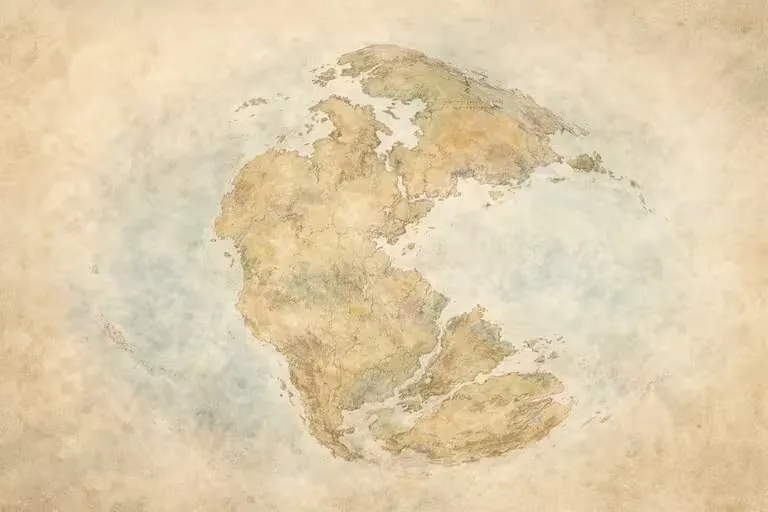
> approximate representation of the supercontinent pangea
the mesozoic climate
section titled “the mesozoic climate”the mesozoic climate, in general terms, was warmer than the current one.
there were no permanent polar ice caps like today’s, and many regions of the planet presented high temperatures for long periods.
but that does not mean that the entire mesozoic was uniform.
throughout this era there were important differences:
- drier stages, especially at the beginning
- wetter and greener periods
- changes in sea level
- very marked regional variations
these changes directly affected vegetation and fauna.
the dinosaurs did not always live in the same type of landscape. some inhabited deserts, others dense forests, coastal plains or swampy areas.
dinosaurs dominate the earth
section titled “dinosaurs dominate the earth”although the first dinosaurs appeared in the triassic, it was during the mesozoic when they became the dominant group on dry land.
their success was not instantaneous. at first they coexisted with many other animals and took millions of years to expand and fully diversify.
over time, very different forms emerged among themselves:
- small bipedal and agile dinosaurs
- huge long-necked sauropods
- large predators
- species with feathers
- horned or armored herbivores
this makes talking about “the dinosaurs” as if they were a single type of animal misleading.
the mesozoic was, in reality, a story of evolutionary diversification.
birds and mammals also emerged
section titled “birds and mammals also emerged”one of the most common mistakes is to think that the mesozoic was an era exclusive to dinosaurs.
in reality, during this stage groups that would later be fundamental also appeared.
among them:
- the first birds, descendants of theropod dinosaurs
- the first mammals, still small and discreet
- new forms of plants and more complex ecosystems
this makes the mesozoic a huge transition stage.
it was not only the time of dinosaur dominance.
it was also the period in which some of the lineages that would end up defining the later world began to appear.
vegetation in transformation
section titled “vegetation in transformation”the mesozoic flora also changed deeply.
at first plants like:
- conifers
- cycads
- ginkgos
- ferns
predominated.
later, especially in the cretaceous, the flowering plants appeared.
this change was decisive because it transformed terrestrial ecosystems and affected the diet of many animals.
the evolution of vegetation and the evolution of dinosaurs were deeply connected.
three great stages
section titled “three great stages”to understand the mesozoic well, it must be divided into its three periods:
triassic
section titled “triassic”the triassic was a stage of recovery and transition.
the first dinosaurs appeared and the bases of the ecosystems that would dominate later began to form.
jurassic
section titled “jurassic”the jurassic was the period in which dinosaurs expanded and diversified spectacularly.
many of the landscapes and animals most iconic associated with popular imagination come from here.
cretaceous
section titled “cretaceous”the cretaceous was the final stage and one of the most complex.
flowering plants appeared, many groups of dinosaurs reached great diversity and finally everything ended with a mass extinction.
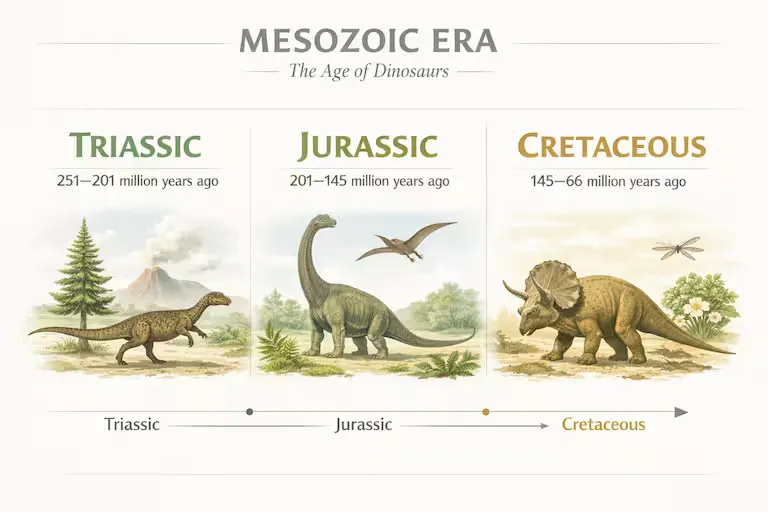
> the mesozoic is divided into triassic, jurassic and cretaceous
the end of the mesozoic
section titled “the end of the mesozoic”the mesozoic ends 66 million years ago with one of the most famous extinctions in the entire history of the planet.
a great impact, along with other environmental factors, triggered a global ecological collapse.
many groups of living beings disappeared, among them all non-avian dinosaurs.
however, not everything ended.
birds are dinosaurs
this means that, in a certain sense, dinosaurs did not disappear completely. a part of their lineage survived and is still alive today.
why the mesozoic was so important
section titled “why the mesozoic was so important”the mesozoic was not just the golden age of dinosaurs.
it was an era of deep transformation for the earth:
- the shape of the continents changed
- new ecosystems evolved
- decisive lineages emerged
- the world was prepared for the subsequent stage
without the mesozoic, the current planet would be unrecognizable.
what comes now
section titled “what comes now”to understand this era in detail, it must be traversed step by step.
first, the triassic, where everything begins.