

jurassic
201 ma → 145 ma
a new stage
section titled “a new stage”the jurassic was the second period of the mesozoic.
it began approximately 201 million years ago and ended 145 million years ago.
if the triassic had been an era of recovery and transition, the jurassic was a stage of expansion.
the great rivals of the dinosaurs had disappeared at the end of the triassic, and that opened the way for this group to diversify extraordinarily.
during the jurassic, dinosaurs stopped being a promising evolutionary possibility and became the true dominators of the earth.
a greener world
section titled “a greener world”the jurassic was, in general, wetter than the triassic.
although not all regions of the planet were the same, the climate favored the expansion of much greener and varied landscapes.
the great deserts of the interior of pangea began to lose prominence as the supercontinent fragmented slowly.
this had very important consequences:
- the influence of the oceans increased
- there was more humidity in many regions
- large forests appeared
- ecosystems became more complex
the planet began to resemble less a arid and extreme world and more a living and changing earth.
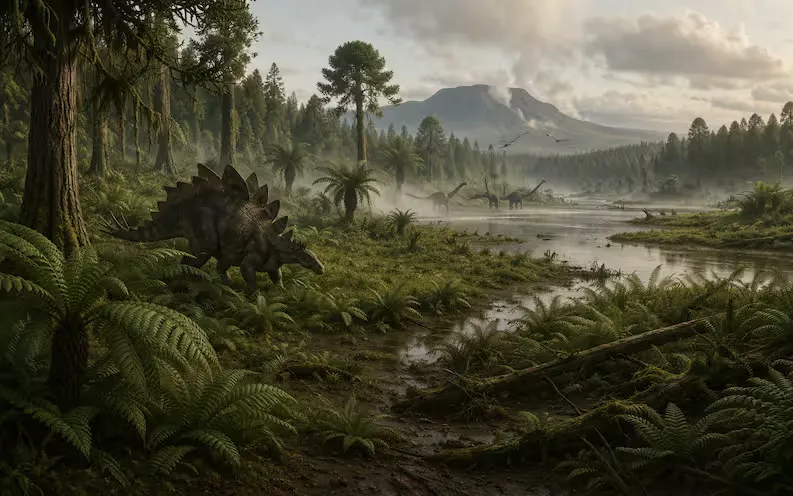
> jurassic landscape with abundant vegetation and a wetter climate than in the triassic
the fragmentation of pangea
section titled “the fragmentation of pangea”during the jurassic, pangea continued breaking.
this process was not fast, but it transformed the geography of the planet little by little.
the separation of continental masses altered:
- ocean circulation
- global climate
- coastal ecosystems
- the distribution of many species
continents still did not have the current form, but the map of the world was beginning to change irreversibly.
the history of dinosaurs was deeply linked to this reorganization of the earth.
the rise of the giants
section titled “the rise of the giants”one of the most famous characteristics of the jurassic was the presence of large herbivorous dinosaurs, especially sauropods.
these animals developed enormous bodies, very long necks and massive tails.
their size allowed them to take advantage of large amounts of vegetation and dominate wide open landscapes and forests.
when we think of giant dinosaurs, many times we are imagining precisely this moment.
during the jurassic, gigantism became one of the most impressive evolutionary strategies of the planet.
predators and balance
section titled “predators and balance”where there were large herbivores, there were also large predators.
the jurassic was not only the age of peaceful giants, but also that of hunters who occupied the top of trophic chains.
these predators coexisted in ecosystems where balance depended on complex relationships between size, speed, feeding and territory.
dinosaurs were no longer small and discreet animals as in the triassic.
in the jurassic, terrestrial ecosystems were clearly organized around their presence.
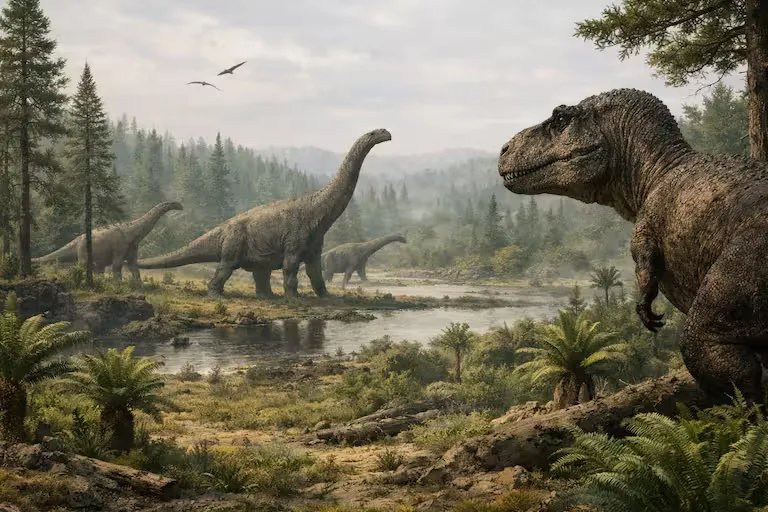
> large jurassic dinosaurs in an ecosystem dominated by herbivores and predators
skies and seas
section titled “skies and seas”the dominance of reptiles during the jurassic was not limited to dry land.
in the skies, pterosaurs continued to expand and occupy different niches.
in the seas, large marine reptiles patrolled oceans and coasts.
this means that the jurassic was a stage of reptilian dominance on a global scale:
- dinosaurs on land
- pterosaurs in the air
- marine reptiles in the water
although not all were dinosaurs, all were part of that great mesozoic world that reached in the jurassic one of its most recognizable moments.
jurassic vegetation
section titled “jurassic vegetation”jurassic landscapes were dominated by plants very different from current ones.
flowering plants did not yet exist, which would appear later.
vegetation was mainly formed by:
- conifers
- ferns
- cycads
- ginkgos
these plant groups supported enormous ecological networks and allowed the existence of large herbivores.
without that plant abundance, the gigantism of many dinosaurs would not have been possible.
the first birds
section titled “the first birds”one of the most important developments of the jurassic was the appearance of the first birds.
these emerged from theropod dinosaurs, which demonstrates that the evolutionary history of dinosaurs was not linear or simple.
the jurassic was not only a stage of dominance of gigantic forms, but also a period of evolutionary innovation.
while some dinosaurs became enormous, others developed traits that later would give rise to birds.
that is why the jurassic is also crucial to understand why current birds are, in evolutionary sense, dinosaurs.
a world in apparent balance
section titled “a world in apparent balance”although from our perspective the jurassic may seem like an era of stability, in reality it was still a dynamic world.
continents continued to separate. climate varied. ecosystems changed. species continued to evolve.
but compared to the harshness of the triassic, the jurassic represents a stage of consolidation.
life had left behind the reconstruction phase and entered an era of splendor.
why the jurassic was so important
section titled “why the jurassic was so important”the jurassic was decisive because it turned dinosaurs into the great protagonists of terrestrial life.
during this period:
- their ecological dominance was consolidated
- many of the most emblematic lineages appeared
- large forest ecosystems developed
- the first birds evolved
- the planet continued to change as pangea fragmented
if the triassic was the beginning, the jurassic was the confirmation.
what comes after
section titled “what comes after”the jurassic was an era of expansion, abundance and dominance.
but the next period would take complexity even further.
in the cretaceous, new landscapes, new plants and some of the most famous dinosaurs of all would appear.