

cretaceous
145 ma → 66 ma
the last great chapter
section titled “the last great chapter”the cretaceous was the third and last period of the mesozoic.
it began approximately 145 million years ago and ended 66 million years ago.
it was a very long, diverse and complex stage.
during this period, dinosaurs reached some of their highest levels of diversity, new forms of vegetation appeared and terrestrial and marine ecosystems transformed deeply.
it was also the final moment of an era.
when the cretaceous ended, the world of dinosaurs would change forever.
a planet increasingly fragmented
section titled “a planet increasingly fragmented”during the cretaceous, the fragmentation of pangea continued advancing.
the continents were already much more separated than in the jurassic, although they still did not have exactly their current form.
this reorganization of the planet decisively affected:
- the global climate
- ocean currents
- species distribution
- the appearance of very different regional ecosystems
as land masses separated, many populations remained isolated and followed their own evolutionary paths.
that favored a great diversification of life.
a very diverse world
section titled “a very diverse world”the cretaceous was not simply “more of the same” compared to the jurassic.
it was a more fragmented, more varied and more complex world.
different regions of the planet housed very different faunas.
in some areas large long-necked herbivores dominated. in others, dinosaurs with horns, armor or specialized beaks. there were also large predators adapted to specific ecosystems.
this makes the cretaceous one of the richest periods in the entire history of dinosaurs.
flowering plants change the landscape
section titled “flowering plants change the landscape”one of the most important changes of the cretaceous was the expansion of angiosperms, that is, flowering plants.
until then, terrestrial ecosystems had been dominated by conifers, ferns, cycads and other older groups.
with the appearance and expansion of flowering plants, the landscape began to change.
this had enormous consequences:
- new food sources emerged
- many ecological chains changed
- ecosystem complexity increased
- new relationships between plants and animals appeared
although conifers and other groups continued to be important, the cretaceous introduced a decisive novelty in the history of terrestrial vegetation.
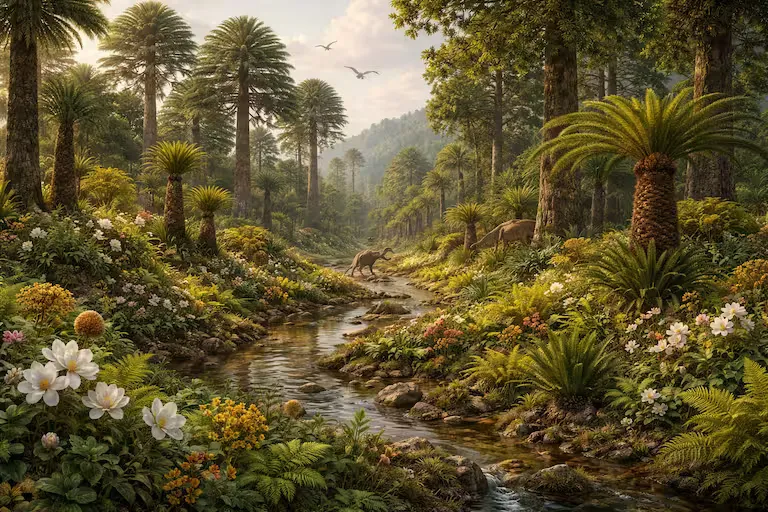
> cretaceous landscape with more complex ecosystems and transforming vegetation
dinosaurs increasingly specialized
section titled “dinosaurs increasingly specialized”in the cretaceous many of the most known dinosaurs appeared and diversified.
among them were:
- large theropod predators
- hadrosaurs with complex adaptations for feeding
- ceratopsids with horns and bone frills
- ankylosaurs with defensive armor
- sauropods that in some regions continued to be dominant
this shows something important:
dinosaurs were not a uniform group
during the cretaceous, evolution produced an enormous variety of forms, strategies and sizes.
some were specialized in cutting specific vegetation. others in defending themselves with armor, tails or horns. others in hunting large prey or taking advantage of very specific niches.
iconic predators
section titled “iconic predators”many of the most famous carnivorous dinosaurs belong to the cretaceous.
this has contributed a lot to the popular image of this period.
however, reducing the cretaceous to a few large predators would be a mistake.
these animals were part of complex ecosystems in which they interacted with an enormous diversity of herbivores, small vertebrates, primitive birds and other organisms.
large predators were only the most visible part of a much wider ecological network.
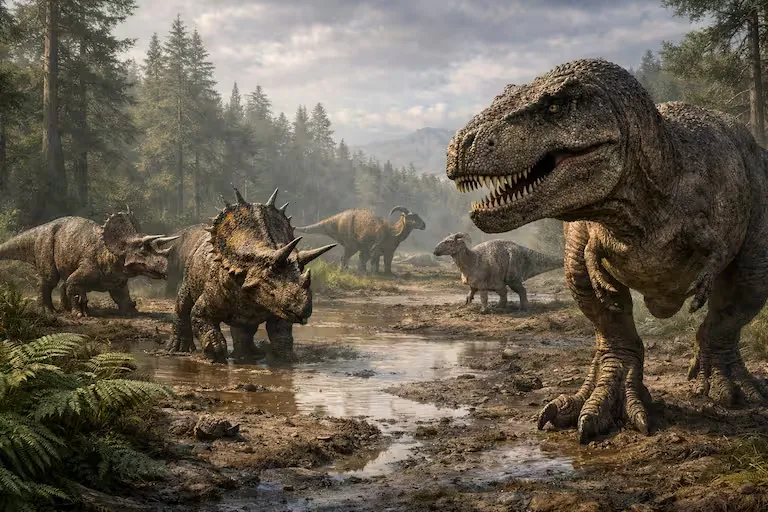
> cretaceous ecosystem with highly specialized dinosaurs and a great diversity of forms
birds, mammals and small survivors
section titled “birds, mammals and small survivors”while dinosaurs dominated large terrestrial ecosystems, other groups continued to evolve.
birds continued to develop from theropod dinosaurs.
mammals were still generally small, but already occupied various niches.
this makes the cretaceous not only an era of giants, but also a stage in which lineages that would survive the great final change were consolidated.
in a certain sense, the cretaceous was the last period of total dominance of non-avian dinosaurs, but not the end of all their descendants.
cretaceous seas and skies
section titled “cretaceous seas and skies”oceans and skies were also full of diverse life.
marine reptiles and other groups adapted to very different environments inhabited the sea.
in the air, pterosaurs were still present, while primitive birds continued to evolve.
this makes the cretaceous a biologically very rich world, not limited to terrestrial landscapes.
life had spread and specialized in all the great environments of the planet.
a balance that seemed stable
section titled “a balance that seemed stable”from a superficial look, the cretaceous might seem like a stage of firm and stable dominance.
ecosystems were complex. dinosaurs were fully established. vegetation was diversifying. continents continued to reorganize.
but that stability was only apparent.
as in other stages of the earth’s history, the balance could break.
the end of the cretaceous
section titled “the end of the cretaceous”66 million years ago, the cretaceous ended with one of the most known extinctions in history.
a great impact, along with enormous scale environmental changes, triggered a global crisis.
its consequences were devastating:
- collapse of food chains
- abrupt climate changes
- disappearance of many animal and plant groups
among the groups that disappeared were all non-avian dinosaurs.
the long dominance of dinosaurs on earth came to an end.
an extinction that was not total
section titled “an extinction that was not total”although we usually talk about the “extinction of the dinosaurs”, the reality is more precise.
not all disappeared
birds, direct descendants of theropod dinosaurs, survived.
this means that a part of the dinosaur lineage managed to cross the crisis and continue to the present.
that is why when we observe modern birds, we are seeing the only dinosaurs that are still alive.
why the cretaceous was so important
section titled “why the cretaceous was so important”the cretaceous was decisive because it took the mesozoic world to one of its points of greatest complexity.
during this period:
- continents continued to separate
- more varied ecosystems emerged
- flowering plants appeared
- many dinosaurs reached enormous specialization
- lineages that would survive later were consolidated
- and finally the great extinction that closed the era occurred
the cretaceous was, at the same time, the culmination of the world of dinosaurs and the beginning of the end of their dominance.
what comes after
section titled “what comes after”with the extinction at the end of the cretaceous the mesozoic ends.
the next great block of the earth’s history will be the cenozoic, a new era in which mammals and other groups will occupy the space left free by the ancient world of dinosaurs.