

paleogene
66 ma → 23 ma
a new beginning
section titled “a new beginning”the paleogene was the first great stage of the cenozoic.
it began approximately 66 million years ago, right after the extinction that ended the cretaceous, and ended 23 million years ago.
the earth had just gone through an immense crisis.
many ecosystems had collapsed. many lineages had disappeared. the mesozoic world had ended.
but the planet did not remain empty.
life began to rebuild once again.
a planet that recovers
section titled “a planet that recovers”during the first moments of the paleogene, the earth was still marked by the consequences of the great extinction.
it was not yet a stable or fully recovered world.
ecosystems were reorganizing and survivors began to expand in a landscape very different from the end of the cretaceous.
in this new scenario:
- many ecological niches had remained empty
- competition had changed completely
- groups previously secondary began to gain importance
the paleogene was, above all, a reconstruction stage.
mammals expand
section titled “mammals expand”one of the most important processes of the entire paleogene was the expansion of mammals.
before the extinction at the end of the cretaceous, mammals already existed, but they usually occupied discreet roles in ecosystems.
after the disappearance of non-avian dinosaurs, many of those limits disappeared.
that allowed mammals to:
- increase in size
- occupy new niches
- diversify rapidly
- develop increasingly specialized forms
the paleogene is the stage in which mammals begin to become great protagonists of terrestrial life.
birds and other survivors
section titled “birds and other survivors”mammals were not the only ones to prosper.
birds, which had already survived the extinction, continued to evolve and expand through different environments.
other groups also persisted such as:
- reptiles
- amphibians
- fish
- numerous invertebrates
- plants that rebuilt the base of ecosystems
the life of the paleogene did not arise from nothing.
it was the continuation of a history that had gone through an enormous crisis, but not terminal.
still different ecosystems
section titled “still different ecosystems”although the paleogene already fully belongs to the cenozoic, its ecosystems were not identical to modern ones.
many landscapes were still different from current ones, and the fauna was still in full reorganization.
there were early forms of mammals that, from the current perspective, may seem strange or intermediate.
this makes the paleogene a particularly interesting stage:
it is a new world, but it is not yet the modern world
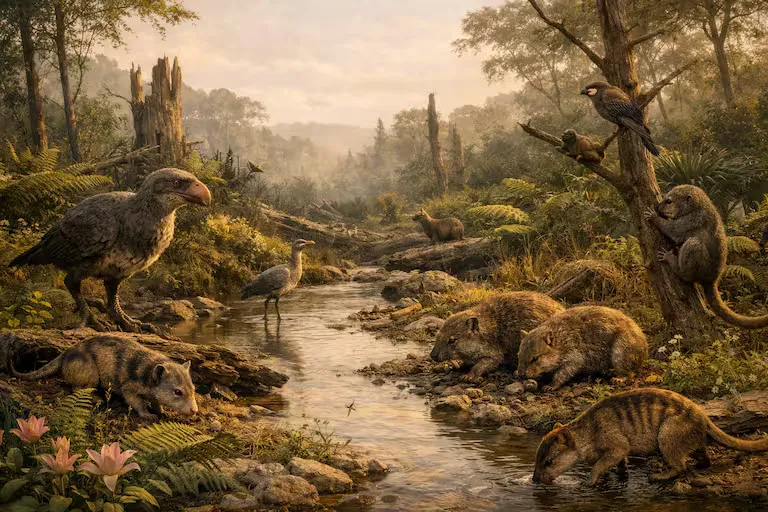
> paleogene ecosystem, when mammals began to expand in a world under reconstruction
changes in climate and continents
section titled “changes in climate and continents”during the paleogene, the earth continued to change also in its geography and climate.
continents continued to move, ocean currents evolved and the climate varied throughout millions of years.
these transformations deeply affected the distribution of life.
animals did not evolve in a fixed scenario, but in a moving planet.
the paleogene was a stage of change not only biological, but also geological and climatic.
the first steps towards a more recognizable world
section titled “the first steps towards a more recognizable world”although there was still a long way to go, during the paleogene forms of life increasingly close to some modern lineages began to appear.
mammals became more diverse. birds continued to specialize. terrestrial ecosystems became more complex.
however, the great open landscapes did not yet exist and many of the typical faunas that we associate with more recent times.
that would come later.
why the paleogene was so important
section titled “why the paleogene was so important”the paleogene was decisive because it defined the real start of the world after the dinosaurs.
during this period:
- life recovered after the extinction
- mammals began their great expansion
- birds continued to diversify
- ecosystems reorganized
- the planet continued to change geographically
if the end of the cretaceous had destroyed a world, the paleogene was the stage in which another began to be built.
what comes after
section titled “what comes after”the paleogene was a stage of reconstruction and initial expansion.
the next great step would be the neogene, when the planet would acquire increasingly modern traits and many ecosystems would begin to look much more like the current ones.